How to Get Featured on Spotify Playlists in 2026
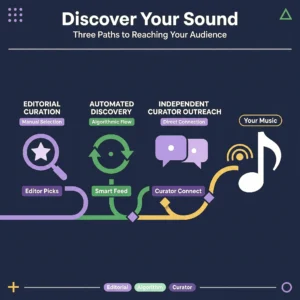
Getting featured on Spotify playlists means having your track selected by an editorial curator, an algorithm, or an independent playlist owner to appear on a public or personalized playlist. It’s not one system — it’s three separate ones, and most artists only ever try one of them. That’s the first thing to fix.
If you’ve pitched through Spotify for Artists and heard nothing back, you’re not alone. According to Spotify’s own data, only around 3% of pitch-tool submissions land an editorial placement. That sounds brutal. It’s also not the whole story, because editorial is just one of three doors — and the other two are far more open than most guides let on.
The 3 Types of Spotify Playlists You Can Actually Target
Editorial, algorithmic, and independent curator playlists work differently, and pitching them the same way is the single biggest reason submissions go nowhere. Editorial playlists (Rap Caviar, New Music Friday) are hand-picked by Spotify’s in-house team through the official pitch tool. Algorithmic playlists (Release Radar, Discover Weekly) are generated automatically from listener behavior — no pitch required, but metadata and early saves matter enormously. Independent curator playlists are run by regular users or small labels, reached through platforms like Groover or SubmitHub, or through direct outreach.
Quick Comparison
| Playlist Type | Best For | Key Benefit | Limitation |
|---|---|---|---|
| Editorial | New releases with strong hook/production | Massive reach if selected | ~3% acceptance rate |
| Algorithmic | Building a catalog over time | Compounds with every save | Slow to build, no direct pitch |
| Independent Curator | Any artist, any follower count | Curators judge the song, not your stats | Reach varies widely by curator |
Spotify’s Fresh Finds ecosystem — the independent-artist arm of algorithmic discovery — has
surfaced more than 70,000 artists across 100+ countries over the past decade. Artists added to a
Fresh Finds playlist typically see their royalties more than double in the following year, according to Spotify’s 2026 Loud & Clear report. That’s not a vanity metric. It’s real money tied to real playlist placement, and it happens without a single editorial pitch.
How to Pitch Your Track Through Spotify for Artists
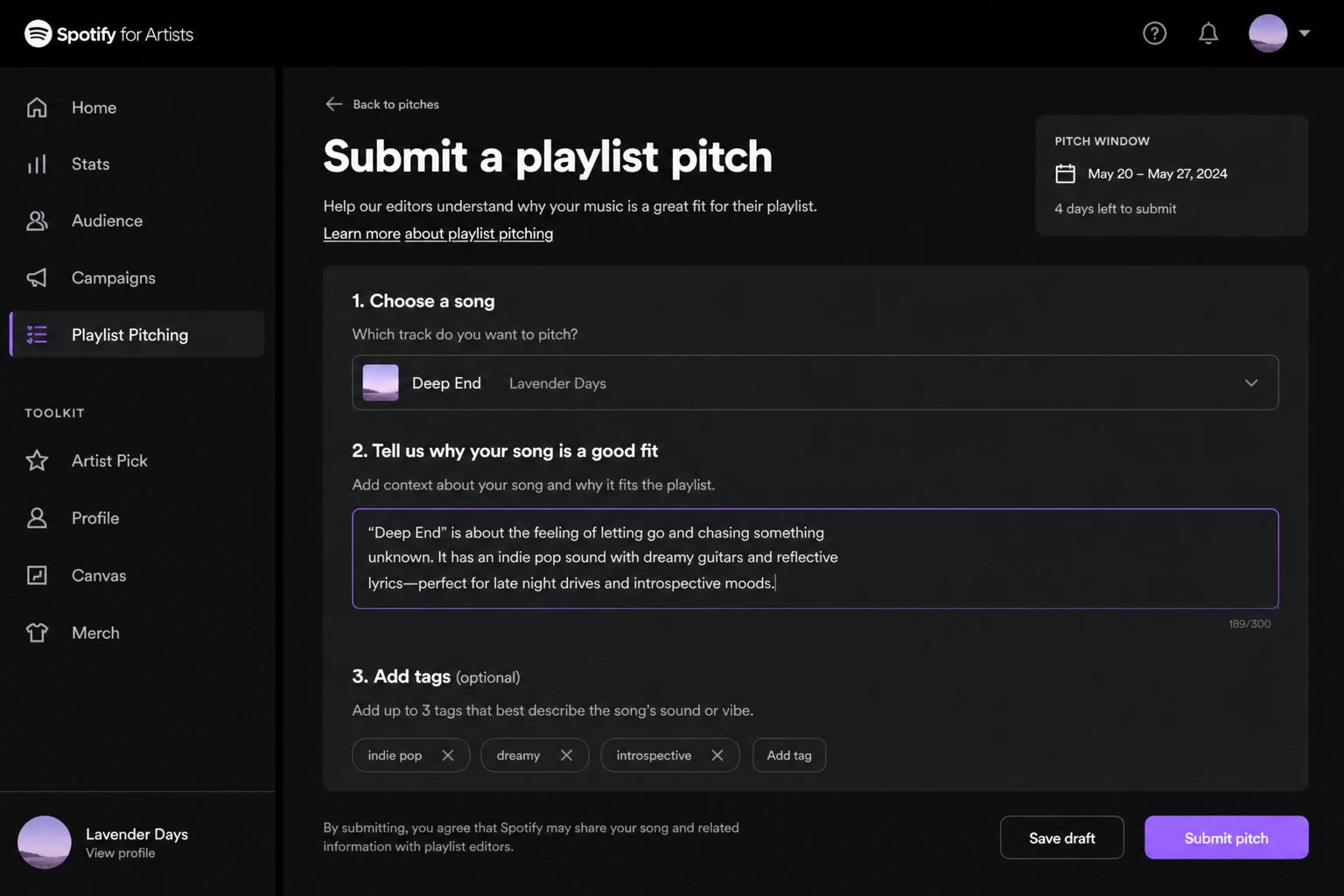
To submit your track for editorial consideration: 1. Open Spotify for Artists and select your unreleased track. 2. Fill in genre, mood, and instrumentation tags precisely. 3. Write your 500-character pitch with a specific story. 4. Submit at least two to three weeks before release.
Here’s the thing: most artists treat that 500-character box like an afterthought. It isn’t. Editors read hundreds of these a day. “Great pop song, hope you like it” tells them nothing. “This atmospheric track is about losing touch with your hometown — built for a night-drive playlist” tells them exactly where it fits and why. Be specific. Name the mood, name the moment someone would play it, and skip the adjectives that don’t do any work.
Genre tags matter more than people think. Don’t tag your song “Pop” because it’s the biggest category — tag it accurately, even if that means a smaller, more precise genre. Editors and the algorithm both use these tags to match your song to the right playlist, and a mismatch gets noticed immediately.
One thing that’s easy to skip: upload a Spotify Canvas — the short looping video that plays behind your track. According to a Wiseband analysis, tracks with a Canvas saw a 27% higher playlist acceptance rate, likely because it signals the release is a real, finished project rather than a rushed upload. It takes ten minutes. There’s no good reason to skip it.
Getting on Algorithmic Playlists Without Pitching Anyone
Release Radar and Discover Weekly don’t take pitches — they respond to behavior. What matters here isn’t stream count. It’s saves. A listener saving your track to their library tells the algorithm something a passive stream never will: this person actually wants to hear it again.
Most people assume follower count decides whether you show up in someone’s Discover Weekly. The data says otherwise — the algorithm is driven by listening patterns and save rates, not profile size. A song with 200 monthly listeners and a high save rate can outperform a song with ten times the audience and low engagement. That’s a genuinely counter-intuitive point, and it’s the one most competitor articles gloss over in favor of vaguer advice like “grow your following.”
What most guides skip entirely is release cadence. Releasing every 4–8 weeks keeps you active in the algorithm’s rotation and puts you back in your followers’ Release Radar each time. A single big album drop every year does less for algorithmic visibility than a steady stream of singles — even if the total song count is the same.
Reaching Independent Curators Directly
Editorial and algorithmic playlists get most of the attention, but independent curators run a huge share of Spotify’s actual listening — one widely cited industry figure puts around 80% of all Spotify streams as coming from playlists, and a large chunk of those are curator-built, not Spotify-owned. This is the door most artists never bother knocking on, and it’s also the one where follower count matters least. Curators aren’t scrolling your profile stats before they hit play. If the song fits their playlist, it goes on — we’ve seen it happen with artists sitting at 200 monthly listeners.
Two platforms make this manageable at scale:
- Groover — every submission guarantees curator feedback within seven days, or you get your credits back. You can filter by genre, country, and playlist reach.
- SubmitHub — connects you with verified, active curators and filters out bot accounts, which is a real problem on this side of the industry.
Direct outreach still works too, especially on Instagram or through curator email addresses listed in playlist bios. Keep the message short: who you are, what the song sounds like, and why it fits their playlist specifically. Generic mass messages get ignored. A message that references the curator’s actual playlist by name gets opened.
I’d push back a little here on paid curator services beyond Groover and SubmitHub — the ones promising “guaranteed adds.” Any service that guarantees placement isn’t using real curators, and Spotify’s fraud detection eventually catches streaming manipulation tied to those services. It’s a controversial take among artists chasing fast numbers, but the acceptance-rate math and the risk of a flagged account both point the same direction: skip it.
Follow up once, briefly, after about a week. Move on after two weeks without a reply. Chasing a curator past that point rarely changes the outcome, and it does cost you time you could spend on the next pitch.
Common Mistakes That Kill Your Playlist Chances
A few patterns show up again and again in rejected or ignored pitches:
- Pitching too late. Submitting the week of release, or after it’s already live, removes editorial consideration entirely.
- Tagging genre for reach instead of accuracy. Mislabeling a folk-pop track as “Pop” to chase a bigger category confuses both editors and the algorithm.
- Skipping the profile basics. An outdated bio, low-res photo, or missing Artist Pick makes a rushed impression even when the song itself is strong.
- Submitting to 200+ curators at once. Twenty to forty targeted submissions outperform a mass blast — curators can tell when a pitch wasn’t written for them specifically.
This guide covers pitching through Spotify for Artists and independent curator platforms. It doesn’t cover paid streaming or playlist-farm services — those violate Spotify’s terms of service and can get a track pulled or an account flagged, regardless of how legitimate they look.
Quick Questions, Answered
Q: What’s the best time to submit a Spotify playlist pitch? A: Two to three weeks before release, using an unreleased track uploaded through your distributor and linked to Spotify for Artists.
Q: How do I get on Discover Weekly without pitching? A: You can’t pitch it directly — focus on save rate, accurate metadata, and consistent releases every 4–8 weeks.
Q: Should I pay for playlist placement? A: No. Guaranteed placement services use fake engagement, and Spotify’s fraud detection can flag or remove your track for it.
Q: Why does my genre tag matter so much? A: Editors and the algorithm both use it to match your song to relevant playlists — an inaccurate tag gets your track routed to the wrong audience or ignored outright.
Q: When should I follow up with an independent curator? A: Once, around a week after your initial message. Move on if there’s no response within two weeks.
Where This Leaves You
Editorial placement is the hardest door and the one everyone fixates on. It’s also just one of three. Algorithmic playlists reward consistency and saves. Independent curators reward a song that actually fits, regardless of your follower count. Work all three, and the odds shift in your favor a lot faster than chasing editorial alone ever will.